
What Is Your Website Actually For?

When I ask a small business owner what their website is supposed to do for them, the question is often met with a pause.
Not because they have not thought about it, but because nobody has ever asked them before.
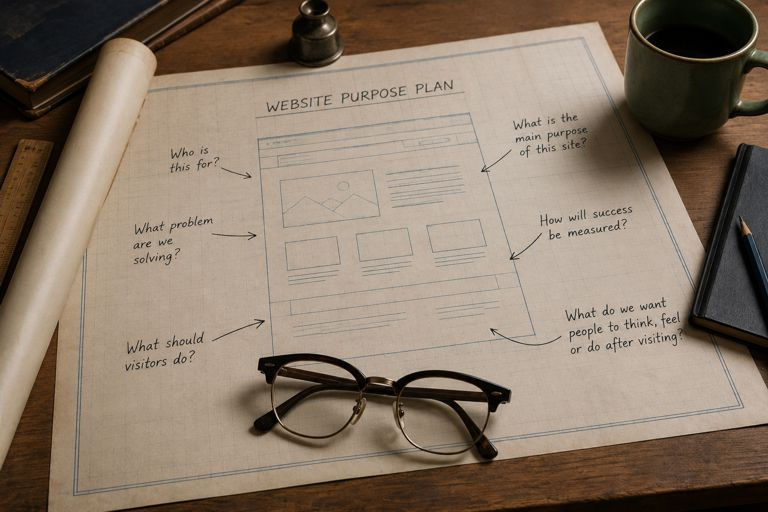
The website exists. It was built. That seemed like the end of the matter.
But a website is a tool, and like any tool, its usefulness depends entirely on what you are trying to achieve. A ruler and a hammer are both useful. They are not interchangeable.
Nobody would buy a hammer and then decide afterwards what they wanted to build. Yet businesses routinely commission websites without first deciding what role the site is expected to perform.
Consider a local plumber who gets most of their work through word of mouth and recommendation. They are unlikely to win a new customer simply because somebody typed "plumber near me" into a search engine and found them. That is a different game, and a competitive one.
But when a neighbour says, "I know a good plumber, let me find you the number," the first thing the potential customer does is look them up.
They want to confirm the business is real. They want to see that it looks professional. They want to find a telephone number and perhaps read a few reviews. The website's job, in that moment, is not to impress.
It is to reassure.
That is a modest purpose. But it is a real and valuable one, and a simple, well-maintained site fulfils it perfectly.
For other businesses, the purpose may be more active. A website might need to generate enquiries, explain a service clearly, support existing customers, showcase previous work, recruit staff, answer common questions, or guide visitors towards making contact.
None of these objectives are wrong.
Problems usually arise when nobody has decided which one matters most.
A site that looks good but leaves the visitor uncertain what to do next has failed at its job, regardless of how attractive it may be.
The mistake many businesses make is to treat the website as an end in itself. Something to have. Something to show. The result is often a site that is pleasant enough to look at but does nothing in particular.
It is worth saying that this is rarely anybody's fault.
Many designers and developers are exceptionally skilled at creating attractive and technically sound websites. However, the broader discussion about purpose, audience and outcomes is often a separate conversation, and it does not always happen before the colour palette is chosen and the logo is sized.
By the time the site is built, the moment to ask those questions has often passed.
There is a moment that many business owners will recognise. The developer finishes the work, sends over the login details, and the project is closed.
What rarely happens during that handover is a conversation about purpose.
What should this website be doing for you six months from now?
How will you know whether it has been successful?
What does success actually look like?
Those questions tend not to get asked, and so the website arrives without a clear brief. It looks the part, but nobody is entirely sure what part it is supposed to be playing.
The problem often compounds over time.
Businesses change. A shop introduces a delivery service. A tradesperson moves into a specialist niche. A practice takes on a new partner. The business moves forward and the website stays where it was, quietly describing a version of the company that no longer exists.
For most owners, this drift goes unnoticed until a customer mentions it, or until they look at the site properly for the first time in two years and wince.
Before spending time or money on a website, whether building one, updating one, or wondering why yours is not doing what you hoped, it is worth being honest about one question.
What do you actually need it to do?
The answer shapes everything else.
For many small businesses, the answer turns out to be simpler than they were led to believe.
Before worrying about search rankings, advertising campaigns, social media strategies or complete redesigns, it is worth answering one simple question.
What is your website actually for?
Everything else becomes much easier once you know the answer.


Comments